Variable Rate Seeding & The Value Behind It
Feb 13, 2025
Written by: Eryn Fenneman, Precision Ag Specialist
IAS’s Precision team is ready to help you gain technology-driven insight on every planted acre.
Farmers have used variable rate technology for many years on their farming operations. Today's variable rate technology uses field data to deliver accurate insights that can help farmers make wise and fruitful decisions.
Variable rate planting represents a move toward a more sustainable and profitable farming method. Understanding this strategy is crucial for farmers who want to maintain their competitiveness and ethical business practices as agricultural issues continue to change.
With that being said, you may not be optimizing every acre by having a fixed population. Variable rate planting is an effective way to make the most out of your unique soils.
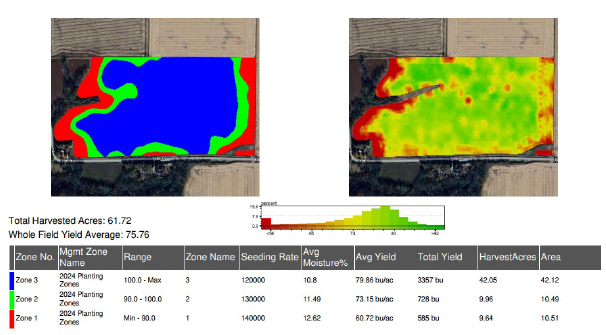
Generally speaking, corn seeding rates are lower in low-productivity zones and higher in high-productivity zones. For soybeans, it would be the opposite. Field size and variability, along with equipment size and capability, will determine the optimal number and size of zones.
Benefits of Variable Rate Planting
- Promoting Sustainability – Optimizing planting and resource input for each distinct field area, depending on changing conditions, is the main goal of variable rate planting. This focused approach not only boosts yield but also responds to the increasing demand for resource efficiency.
- Enhancing Productivity – Farmers can optimize production potential by identifying and adapting to changing field conditions that will impact their seeding rate and yield. This advantage is essential given the rising demand for food worldwide.
- Increasing Profitability – A flat rate application of seeds may result in overuse, wasted resources and driving up farmer expenses. Precise input control is made possible by variable rate planting, which eventually results in lower expenses and more profit.
- Putting Your Yield History to Use – A farmer can use past yields on each farm to better their future yields. By using our advanced technology systems, we can overlay past yield maps with new seeding zones to try to overcome the areas in the field that have performed below average in the past.
- Planning for the Future – When working with us, we can evaluate hybrid aspects such as ear girth, kernel development and stalk strength, and how the population in certain areas of the field has impacted those yield variables. Having a plan for each year, you can feel validated in your future planting decisions.